
It was the crackle of lightning across the Windward Plains that first made Jaxon stop dead in his tracks. He had been tracking an Arkveld, the supposed crown jewel of Monster Hunter Wilds, for the better part of an afternoon. The beast was everywhere in the promotional material—a magnificent, chain-laden wyvern that had graced the cover and headlined the beta tests. Capcom had placed its bets on this elder-level monster back in 2025, and the gamble paid off commercially: the game rocketed past ten million copies in its first month. But on this humid evening in mid-2026, with a fully upgraded charge blade on his back and a year’s worth of hunts behind him, Jaxon realized that the marketing machine had perhaps anointed the wrong creature.
The Arkveld was a formidable opponent, no doubt. It whipped its chain-like appendages with a domineering grace, and its ability to absorb energy from the environment gave it an air of primordial menace. Yet as the months rolled on, the community’s infatuation began to wane. Hunters who had cut their teeth on the ferocious Nergigante in World, or the apocalyptic Fatalis, found themselves dealing with something that, while visually striking, felt like a narrative downgrade. Arkveld’s turf wars were scarce, its behavior felt scripted, and its presence on the box art started to feel like a promise not fully kept. The real star, Jaxon had come to believe, was soaring elsewhere.
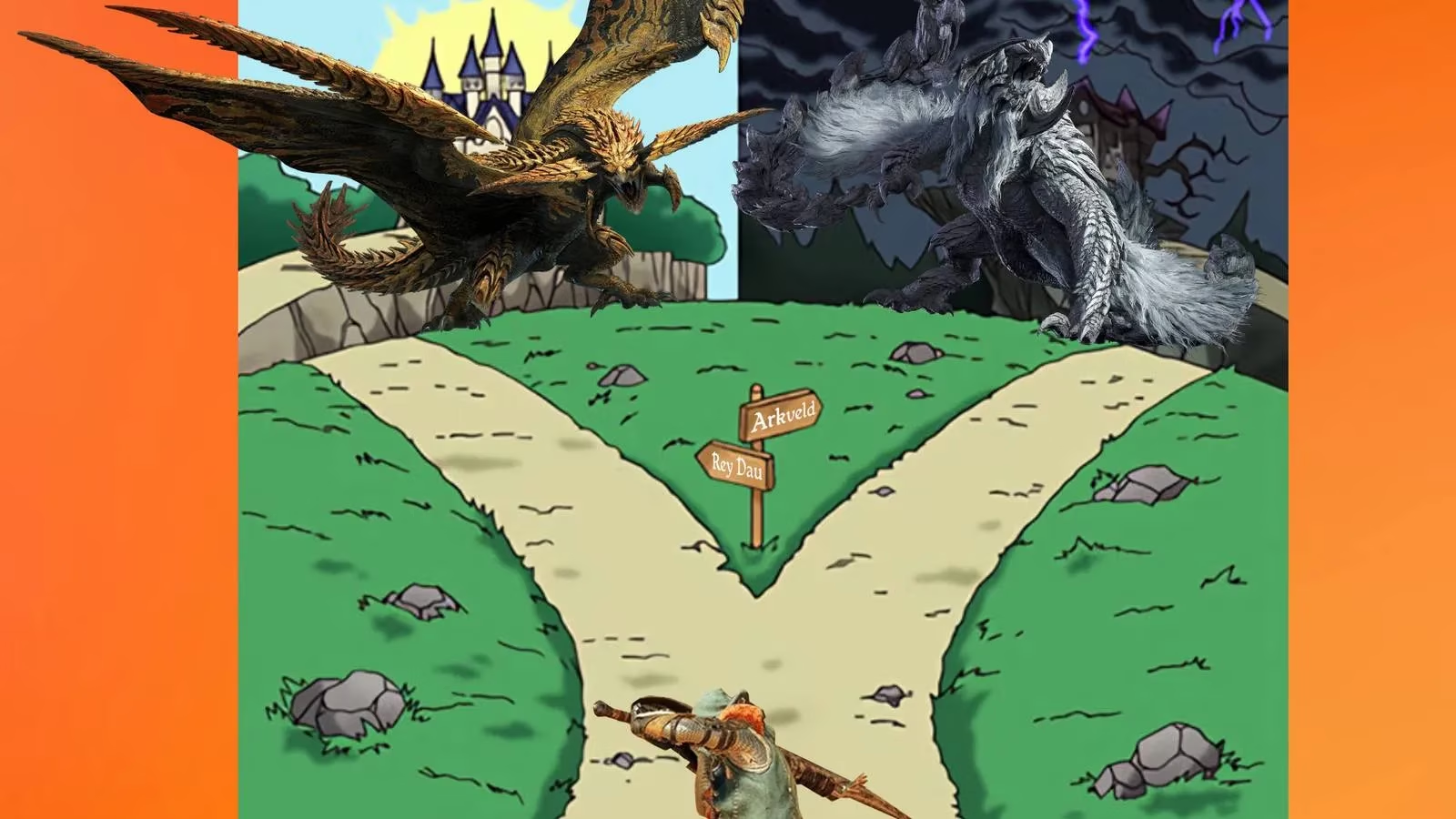
Rey Dau does not announce itself with chains and dark theatrics. It announces itself with a screech that cuts through thunder, followed by a supersonic blast of concentrated lightning that leaves a steaming trench in the earth. Jaxon had encountered it for the first time during a routine expedition, and the moment’s sheer spectacle etched itself into his memory. The monster’s head crest unfurls into a natural railgun, charging a projectile of pure electromagnetic fury that can one-shot an unprepared hunter. It’s the kind of attack that makes you laugh out loud in disbelief before you even process the cart ride back to camp. The fight is not just a slugfest; it is a dance across a landscape constantly ignited by lightning strikes, the sky turning into a strobe-lit arena. For Jaxon, and for thousands of hunters who frequented forums like the Monster Hunter subreddit, that single ability transformed the experience from a hunt into a rock concert.
The fan consensus crystallized into something of a quiet rebellion. In a thread posted a month after launch, a user named Rathalos-487 asked what players truly thought of Arkveld one month in. The responses were a drip feed of polite disappointment. “I was farming both last night,” one comment read, “and while Arkveld’s concept is cool and it’s a fun fight, Rey Dau is just so much cooler and fighting it makes you feel so much more badass. It’s like, who’s cooler? The chains and whips dom dragon? Or the f***ing flying rail gun dragon who you fight with a bunch of lightning striking all over the battlefield?” The comparison was unfair and glorious. Arkveld, once the darling of the beta, was now being sized up against a monster that literally defibrillated itself.
That last detail became the stuff of legend. Rey Dau possesses a trait no other monster in Wilds shares: it can resuscitate itself from the brink of death. When the beast collapses, seemingly slain, a surge of internal bioelectricity arcs through its body, jolting it back to life for one final, desperate phase. Hunters who had already sheathed their weapons and started carving mentally were met with a horrifyingly metal resurrection. “From the sound design to the monster, just so cool,” another player wrote. “Also the fact that it’s the only monster in the game that literally resuscitated itself from death. That was just so f***ing metal.” The move feels like the monster’s own roar of defiance, a refusal to be written off, and it turns every encounter into a story you retell at the canteen.
Jaxon had witnessed that revival three times now, and it never grew old. The first time, he panicked and fainted to a tail swipe. The second time, he managed to land the final blow as the lightning receded. The third time, he just stood there in awe, letting the moment wash over him while his palico frantically tossed a vigorwasp. It occurred to him that this is what a flagship monster should evoke: not just challenge, but a feeling of facing something truly singular and mythical. Arkveld’s chains were an intriguing motif, but they pulled from a familiar design language of domination and imprisonment. Rey Dau’s railgun was a bolt from the future, a weaponized thunderstorm that felt more at home in a sci-fi epic than a fantasy ecology. That audacity captured the imagination.
Perhaps Capcom’s choice was strategic. Revealing Arkveld early allowed the development team to test its sprawling new open-world systems in the beta without spoiling the real jaw-droppers. Maybe Rey Dau was always intended to be the secret heart of the game, the discovery that players would make on their own and claim as theirs. If so, the strategy worked. Streamers regularly pause their Arkveld speedruns to take on a tempered Rey Dau just for the visual feast. Fan art galleries are dominated by glowing illustrations of the horned wyvern in mid-discharge. Cosplayers have rigged elaborate LED setups to mimic the creature’s crest. The monster has been adopted as the community’s unofficial emblem.
Looking back from the vantage point of 2026, with the game now enriched by several title updates and a Master Rank expansion on the horizon, the revisionist history feels almost complete. Arkveld remains a fine monster, a worthy challenge, and a central figure in Wilds’ plot. But ask a hunter which creature made them fall in love with the game, and the answer is increasingly Rey Dau. The plains are still dangerous, the lightning still unpredictable, and that railgun dragon is still out there, defibrillating itself back into the fight, forever the true cover star in the eyes of those who actually live in the world.